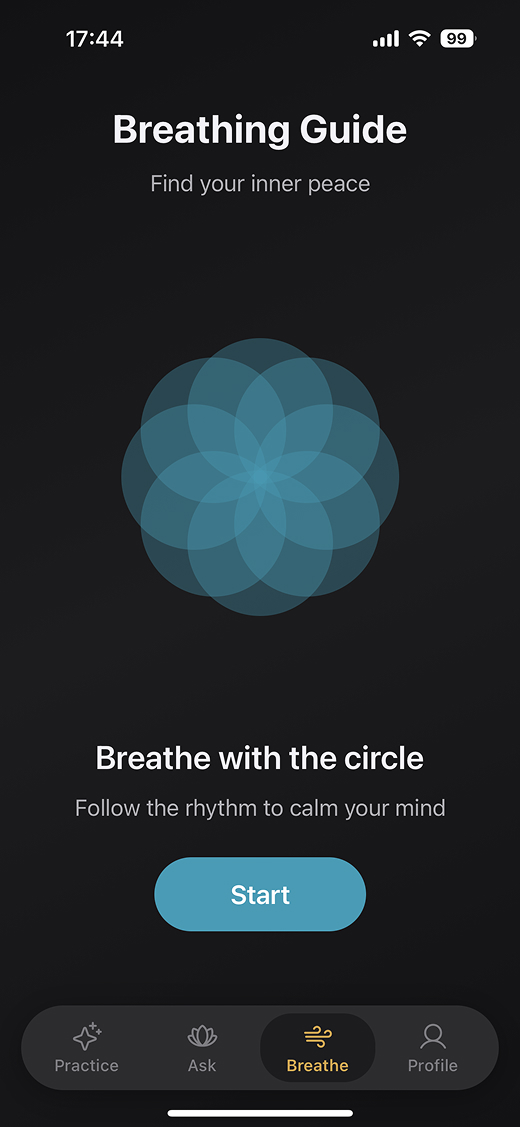
Breathing Guide: Four Buddhist Breathing Techniques for a Calmer Mind
Sometimes you don’t need advice. You don’t need a question to sit with. You don’t even need words. You just need a moment to stop and breathe. The Breathing Guide in the Choose Like Buddha app offers four guided breathing techniques drawn from Buddhist and contemplative traditions — each designed to help you calm the nervous system, steady the mind, and return to the present moment.
Why Breathing Practice Works
Slow, deliberate breathing is one of the oldest and most reliable ways to calm the nervous system. It signals to your body that you are safe, even when your mind is racing. Modern research on vagal tone, heart rate variability, and parasympathetic activation confirms what contemplatives have known for thousands of years: how you breathe changes how you feel, think, and decide.
The Breathing Guide gives that ancient practice a gentle, visual rhythm you can follow anywhere — before a hard conversation, in the middle of a stressful day, or right before sleep.
The Four Breathing Techniques
1. Sama Breathing (Equal / Box Breathing)
What it is. Sama vritti — Sanskrit for “equal movement” — is the classic equal-count breath. You inhale, hold, exhale, and hold again for the same number of seconds, tracing the four sides of a square. In modern settings it’s often called box breathing, popular with athletes, first responders, and Navy SEALs.
When to use it. Before a stressful meeting, when anxiety spikes, or any time you need to reset focus quickly. Sama breathing is the fastest way to feel measurably calmer in under two minutes.
How it helps. The equal rhythm and short breath holds activate the parasympathetic nervous system, slow the heart rate, and give the mind a simple, symmetric anchor to return to.
Try it now. Use the free Box Breathing Tool — a guided 4-4-4-4 visual timer, right in your browser.
2. Ānāpānasati (Mindfulness of Breathing)
What it is. Ānāpānasati is the foundational Buddhist breath meditation, taught directly by the Buddha in the Ānāpānasati Sutta. The word joins ānāpāna (in-breath and out-breath) with sati (mindfulness). Unlike counted techniques, you don’t change the breath — you simply pay close, gentle attention to it as it already is.
When to use it. For daily meditation, longer sits, or any time you want to build sustained awareness rather than a quick reset. It’s the entry point to deeper insight practice.
How it helps. Ānāpānasati trains concentration and awareness together. Over time it develops the ability to notice thoughts and emotions as they arise — the foundation of every Buddhist path to inner freedom.
3. Mettā Breathing (Loving-Kindness Breath)
What it is. Mettā breathing pairs the rhythm of the breath with the practice of mettā — loving-kindness. On the in-breath you draw in warmth and compassion for yourself; on the out-breath you extend that same warmth outward — to someone you love, someone you struggle with, and ultimately all beings.
When to use it. After conflict, when you’re being hard on yourself, when holding a grudge, or when you simply want to soften. Mettā breathing is especially powerful before reaching back out to someone after a difficult exchange.
How it helps. Combining breath and compassion rewires the emotional response to stress. Research on loving-kindness meditation shows measurable increases in positive emotion, social connection, and self-compassion after regular practice.
4. Vase Breathing (Kumbhaka / Tibetan bum pa can)
What it is. Vase breathing — kumbhaka in Sanskrit, bum pa can (“vase-like”) in Tibetan — is a traditional breath-retention practice from Tibetan Buddhist yoga. After a full inhale, you gently hold the breath low in the abdomen, shaping the belly like a round vase, before slowly releasing.
When to use it. When you feel scattered, cold, or low on energy, or when you want to deepen a seated meditation. Vase breathing is more advanced — approach it gently, and never force the hold.
How it helps. The held breath generates inner warmth and focus, which is why it’s a preparatory practice for tummo (inner-heat yoga) and trul khor in the Tibetan tradition. Shorter, softer versions are safe and calming for daily practice.
Which Technique Should You Choose?
| Situation | Best technique |
|---|---|
| Quick anxiety reset | Sama / Box breathing |
| Daily meditation practice | Ānāpānasati |
| Healing after conflict | Mettā breathing |
| Deepening focus and warmth | Vase breathing |
You don’t need to pick just one. Many practitioners start the day with Ānāpānasati, use Sama breathing during stressful moments, and close with Mettā breathing before bed.
When to Breathe
- Before a hard conversation
- In the middle of a stressful day
- When you can feel anxiety building
- Right before sleep
- During a meditation session
- Any time you notice you’ve been holding your breath without realizing it
Frequently Asked Questions
Do I need meditation experience to use the Breathing Guide? No. Each technique is introduced with a simple visual rhythm you can follow on your first try.
Is breath retention (Vase breathing) safe? For short, gentle holds, yes. If you have cardiovascular, respiratory, or blood-pressure conditions — or if you’re pregnant — consult a qualified teacher or physician before practicing longer retentions.
Is the Breathing Guide free? Sama (Box) breathing is free on the Free Path of the Choose Like Buddha app. Ānāpānasati, Mettā, and Vase breathing are included in the Enlightened Path premium plan.
Is my practice private? Yes. Choose Like Buddha is privacy-respecting and ad-free. See the Privacy Policy for details.
Start With One Breath
Four techniques. Thousands of years of wisdom. One quiet moment in your day. Download Choose Like Buddha, choose a rhythm, and begin again — one breath at a time.